

Aquaculture has moved far beyond the simple idea of raising fish or shrimp in ponds. Modern farms increasingly rely on carefully managed feeding programs, accurate nutrition, efficient production systems, and close monitoring of animal performance. As farming densities increase and producers seek better feed conversion, the quality and consistency of manufactured feed have become more important than ever.
Feed is often one of the largest operating expenses on an aquaculture farm. At the same time, poor-quality feed can create problems that extend beyond feed costs. Pellets that break down too quickly may release valuable nutrients into the water. Feed that is too difficult for animals to consume can increase waste. Inconsistent pellet size can create uneven feeding, particularly when animals of different growth stages are being managed.
For these reasons, feed production should be considered part of the overall aquaculture strategy rather than simply a manufacturing activity.
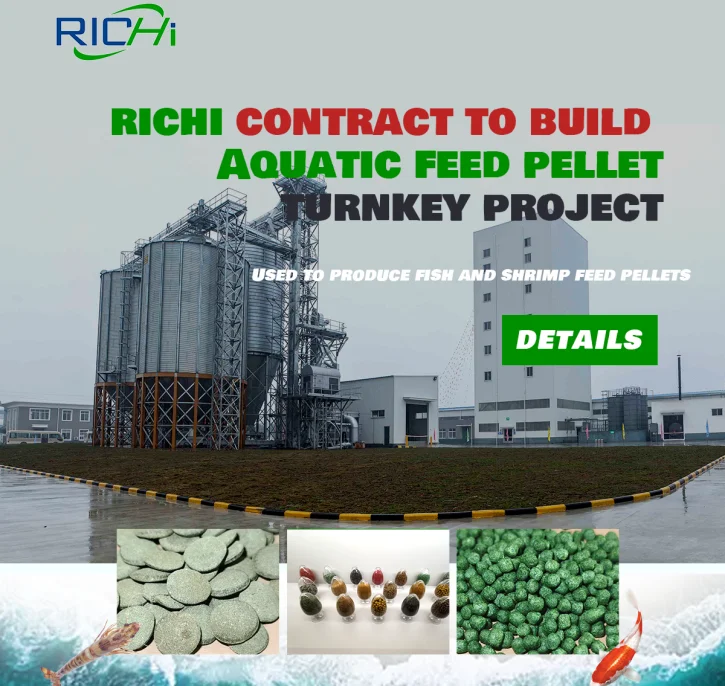
A modern aquatic feed pellet plant can integrate raw material preparation, grinding, mixing, extrusion, drying, cooling, coating, screening, and packaging into a coordinated production system. Yet successful production depends on much more than equipment selection. The formula, target species, pellet characteristics, raw materials, production capacity, and downstream handling all need to be considered together.
The Real Objective Is Not Simply More Pellets
It is easy to measure feed production by tons per hour.
However, high output alone does not mean that a plant is performing well.
A feed manufacturer may produce a large quantity of pellets, but if those pellets have inconsistent density, excessive fines, poor water stability, or unsuitable dimensions, much of the production advantage can disappear at the farm level.
A more useful objective is to produce the right feed consistently and efficiently.
That means understanding the relationship between:
- Raw materials
- Feed formulation
- Particle size
- Mixing quality
- Processing technology
- Pellet dimensions
- Density
- Water stability
- Drying
- Cooling
- Coating
- Storage
Every stage contributes to the final product.
Different Species Need Different Feed
One of the first mistakes in feed plant planning is assuming that all aquatic animals can use the same type of pellet.
They cannot.
Shrimp, tilapia, carp, catfish, salmon, trout, and other aquatic species have different feeding behaviors and nutritional requirements.
Some fish species feed actively at the water surface and respond well to floating feed. Others feed in the middle or lower part of the water column. Shrimp typically consume sinking feed around the bottom of ponds or tanks.
Even within the same species, feeding requirements can change according to age and growth stage.
Juvenile fish may need extremely small particles, while larger fish can consume larger pellets. Shrimp feed may also be produced in several sizes to match different growth stages.
Therefore, the first question when designing a feed plant should not be “Which machine should I buy?”
It should be “What type of feed do I need to manufacture?”
Start with the Formula
Once the target species and feed type have been identified, formulation becomes the next priority.
Aquatic feed can contain a wide range of ingredients.
Protein sources may include fish meal, soybean meal, poultry by-products, insect meal, or plant protein concentrates. Grain-based ingredients can contribute starch and energy, while oils increase dietary energy density and may contribute essential fatty acids.
Minerals, vitamins, attractants, enzymes, pigments, and other functional ingredients may also be added depending on the application.
These ingredients do not behave identically during processing.
Some improve binding. Some increase lubrication. Some change expansion during extrusion. Others influence water stability or pellet hardness.
Consequently, the processing system should be designed around the actual formula rather than a generic specification.
Why Raw Material Quality Matters
Even advanced equipment cannot completely compensate for unstable raw materials.
Moisture variation, inconsistent particle size, excessive fiber, or changes in ingredient quality can cause differences in production performance.
For example, one batch of wheat flour may contain a different moisture level from another shipment. A soybean meal with different physical characteristics may alter extrusion behavior.
This is why professional feed manufacturers often establish raw material inspection procedures before ingredients enter the main production process.
Checking incoming materials can help control:
- Moisture
- Particle size
- Bulk density
- Foreign materials
- Storage condition
- Consistency between batches
Stable raw materials create a more predictable production environment.
Grinding Is a Foundation Process
Particle size affects almost every downstream stage.
Inadequately ground ingredients can lead to uneven mixing and poor pellet formation. Extremely fine particles may improve some aspects of processing but can also increase energy consumption and dust generation.
The target particle size should therefore be based on the product.
Small fish feed and shrimp feed often require relatively fine raw material preparation because the finished pellets themselves can be very small.
A well-designed grinding system should produce a consistent particle distribution without unnecessary energy consumption.
This is one reason the grinder should be selected together with the rest of the feed processing system.
Mixing Is Critical for Nutritional Consistency
A feed formula is only useful if it is distributed correctly.
Imagine a recipe containing ten or more ingredients, some of which are included at very low percentages. If mixing is incomplete, different portions of the batch can contain different concentrations of nutrients.
This creates a hidden quality problem.
The final pellets may look identical, but animals may receive slightly different nutrient profiles.
A properly selected mixer should achieve good uniformity while minimizing segregation during discharge and conveying.
Mixing time, loading level, ingredient order, and material characteristics can all influence the result.
Why Extrusion Is Important in Aquatic Feed
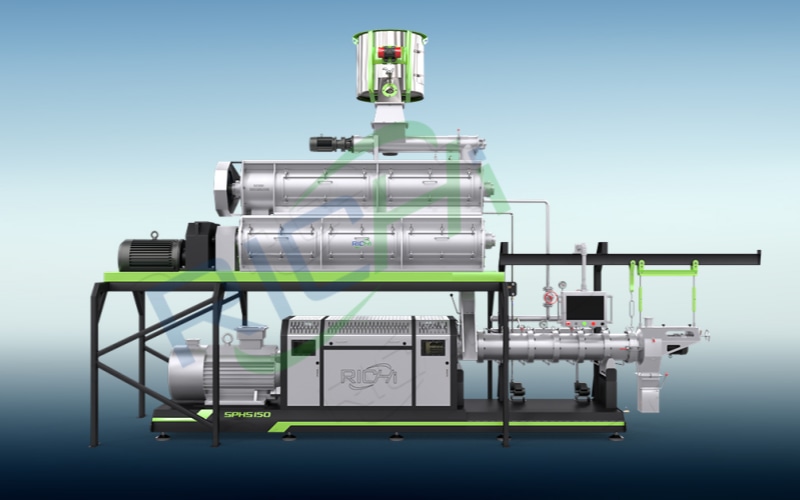
Extrusion is widely used for aquatic feed because it provides strong control over pellet structure.
Inside the extruder, ingredients are exposed to heat, moisture, pressure, and mechanical shear.
These conditions can change the physical properties of the feed mixture and allow the manufacturer to create different pellet structures.
One important advantage is the ability to influence pellet density.
With appropriate processing conditions, manufacturers can produce floating, sinking, or slowly sinking products.
This flexibility is especially valuable for feed producers who serve different species and farming systems.
Floating Feed Is About Density and Structure
Floating fish feed is popular because farmers can observe the pellets at the water surface.
This makes feeding management easier.
If fish stop consuming the feed, operators may notice quickly and reduce the feeding rate. This can help limit unnecessary feed waste.
However, producing a stable floating pellet requires careful control of expansion and internal structure.
The formula must contain suitable components, and the extrusion process must create the desired pellet density.
Temperature, moisture, screw configuration, die design, and operating conditions can all influence the final product.
The process therefore requires more than simply pushing ingredients through a die.
Sinking Feed Has Different Requirements
Sinking feed needs a different density profile.
If pellets are too light, they may remain near the surface longer than intended. If they are too dense, they may sink rapidly and collect in areas where animals cannot consume them efficiently.
The ideal sinking behavior depends on the species and farm environment.
For shrimp, the objective is often to create a pellet that reaches the feeding area efficiently while remaining stable long enough for the animals to consume it.
This makes density control and water stability particularly important.
Shrimp Feed Requires Special Attention
Shrimp feed is a good example of why feed production cannot rely on a one-size-fits-all approach.
Shrimp often feed near the pond bottom, and farmers may need to distribute feed across a wide area.
The pellets must be attractive and sufficiently stable in water.
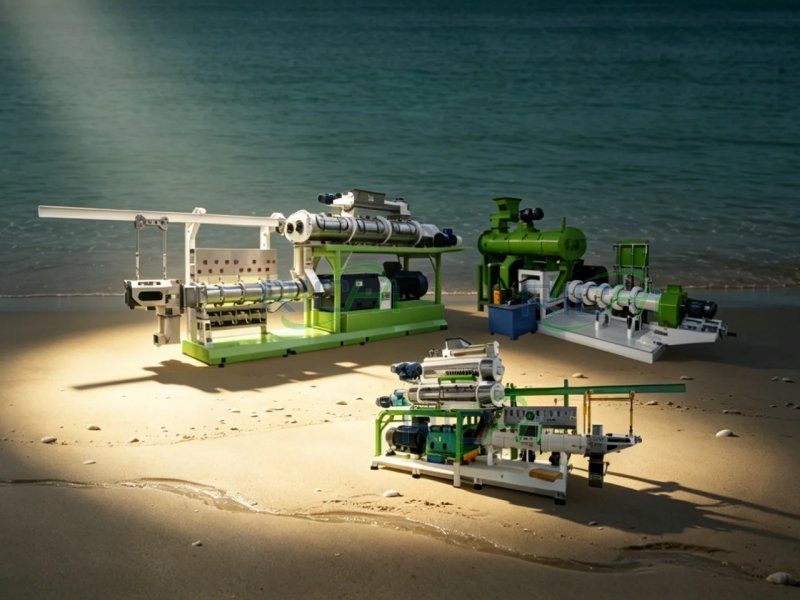
A producer evaluating a 2-3 T/H shrimp feed processing plant for sale should therefore examine much more than the nominal production capacity.
The formula, pellet diameter, water stability, drying system, coating method, screening accuracy, and automation level can all affect the final result.
A plant that technically produces 3 T/H may not be the best choice if its process cannot consistently manufacture the required shrimp feed specification.
Water Stability Can Influence Farm Economics
In terrestrial feed production, pellet durability during transportation is often a major concern.
In aquaculture, another question appears:
What happens after the pellet enters water?
A pellet that disintegrates rapidly may release proteins, oils, vitamins, and other valuable components before the animal eats them.
This creates both economic and environmental costs.
Uneaten nutrients can contribute to organic loading in the farming environment.
Good aquatic feed therefore needs a suitable balance between physical integrity and digestibility.
The right level of water stability depends on the target species and feeding conditions.
Drying Is Not Just Moisture Removal
After extrusion, aquatic feed often contains more moisture than is appropriate for storage.
Drying reduces this moisture to a suitable level.
But the process needs to be controlled carefully.
Excessive drying may increase energy consumption and potentially alter pellet characteristics. Insufficient drying can shorten storage life and create stability problems.
Drying conditions should therefore be optimized according to:
- Pellet size
- Formula composition
- Initial moisture
- Target final moisture
- Production capacity
- Heat-transfer characteristics
The dryer should also be matched to upstream output.
If extrusion is faster than drying, the dryer becomes a bottleneck.
Cooling Protects the Finished Product
Freshly dried pellets are hot.
Packaging them immediately may create temperature and moisture differences inside bags or bulk storage systems.
(Related Post: https://www.richipelletmill.com/twin-screw-fish-feed-extruder/)
Cooling reduces product temperature and helps stabilize the finished feed.
A properly sized cooling system can improve storage quality and reduce the risk of condensation.
Cooling is especially important in warm climates, where storage temperatures may already be high.
The complete production line should therefore consider both drying and cooling rather than treating them as secondary components.
Coating Can Add Functional Value
Many aquatic feeds contain oils or other liquid ingredients.
Depending on the formulation, some of these materials may be added after extrusion and drying.
A coating system can improve the distribution of oil, attractants, and certain functional components over the finished pellet.
This may help manufacturers produce high-energy diets while maintaining suitable extrusion conditions.
The coating process needs to be uniform.
Uneven application can produce variation in pellet appearance, energy density, and storage characteristics.
For commercial production, accurate coating is therefore part of quality control.
Pellet Diameter Is More Important Than It Appears
Feed size needs to match animal mouth size and feeding behavior.
Using the wrong pellet size can reduce feeding efficiency even if the formula itself is nutritionally balanced.
For this reason, commercial feed plants often need several pellet sizes.
Changing pellet dimensions may require different dies, screening systems, or processing settings.
A producer planning multiple products should determine this requirement early in the plant design stage.
Doing so can prevent expensive modifications later.
How Automation Changes the Production Process
Automation has become increasingly useful as feed plants become larger and more complex.
Automatic batching can reduce weighing errors.
Automated control systems can manage production parameters.
Temperature and moisture monitoring can provide real-time information.
Automatic packaging can reduce labor requirements.
These systems can also help standardize production between batches.
However, automation should be matched to actual needs.
A small farm producing feed for internal use may not require a sophisticated control system.
A large commercial manufacturer serving multiple markets may benefit considerably from centralized automation.
Capacity Planning Should Start with Demand
Capacity is another area where careful planning matters.
A plant should be sized according to actual feed requirements rather than maximum possible production.
A useful starting point is to calculate:
Daily feed requirement ÷ planned operating hours = approximate hourly production requirement.
The producer can then account for cleaning, maintenance, product changes, and expected growth.
This allows some flexibility without creating excessive idle capacity.
A machine operating close to its practical production range may provide better economics than an oversized machine running only occasionally.
Why Process Balance Matters
A feed plant is a chain.
If one section is too slow, it affects the entire production system.
For example, a high-capacity extrusion line cannot operate efficiently if the grinder cannot prepare enough material.
Likewise, a fast extruder can overwhelm a small dryer or cooler.
A packaging machine that cannot keep up may force operators to slow the upstream process.
Plant design should therefore focus on balanced capacity.
The goal is a continuous material flow from raw material receiving to finished feed storage.
Energy Efficiency Needs a System-Level Approach
Feed production consumes energy at multiple points.
Grinding uses electricity.
Extrusion requires mechanical power and often thermal energy.
Drying can become one of the most energy-intensive stages.
Cooling, conveying, coating, and packaging also contribute.
Improving energy efficiency therefore requires looking at the entire system.
Efficient motors, properly sized equipment, heat recovery, insulation, optimized drying conditions, and reduced idle running time can all help control production costs.
Energy consumption should ideally be evaluated per ton of finished feed rather than by installed power alone.
Storage Is Part of Feed Quality
Once the feed leaves the production line, quality still needs to be protected.
Finished feed should be stored in clean, dry, and well-ventilated conditions.
High humidity can create problems.
Temperature fluctuations can lead to moisture movement.
Improper storage can allow a high-quality product to deteriorate before reaching the farm.
Bulk storage systems should also be designed to limit segregation.
Bagged feed requires suitable packaging and careful handling during transportation.
Preventive Maintenance Supports Consistent Production
Production stability is not only about operating the equipment correctly.
Maintenance also matters.
Dies, screws, bearings, cutters, screens, conveyors, dryers, fans, and coating systems all experience wear.
A worn component can gradually change product quality before causing an obvious breakdown.
Operators should monitor unusual vibration, temperature changes, motor load, pellet dimensions, output, and fines.
Scheduled inspection can identify these changes early.
Preventive maintenance often costs far less than unplanned production downtime.
Choosing a Project Partner
Feed plant buyers should evaluate suppliers based on more than equipment price.
A capable project partner should understand:
- Feed formulation
- Raw material characteristics
- Processing technology
- Plant layout
- Capacity balancing
- Automation
- Installation
- Operator training
- Spare parts
- After-sales service
Companies such as Richi Machinery can provide equipment and engineering support for feed processing projects, but buyers should always evaluate a proposed system according to their own product requirements and operating conditions.
The most important question is whether the supplier understands the complete production process.
Why Testing Matters Before Large Investments
Raw materials can behave differently from expectations.
A formula may look suitable on paper but create unexpected issues during actual production.
Trial production can help identify problems with pellet formation, moisture, expansion, density, water stability, or drying.
For new projects, small-scale testing can provide useful information before the final plant configuration is confirmed.
This is especially valuable when producers plan to use unconventional raw materials or develop new feed products.
Building Flexibility into the Plant
Aquaculture markets change.
A feed manufacturer may begin with one species and later add another.
A shrimp feed producer may eventually introduce fish feed products.
A local farm may become a commercial feed supplier.
For this reason, flexibility can be valuable.
Plant layouts can leave space for additional storage, conveyors, extruders, dryers, or packaging equipment.
Dies can be designed for multiple pellet sizes.
Control systems can support additional formulas.
A flexible plant may be more valuable over its lifetime than a system optimized only for today’s product.
Common Mistakes to Avoid
Several common mistakes can make an aquatic feed project less efficient.
Selecting Equipment Before Defining the Product
Without clear product specifications, it is difficult to choose appropriate processing technology.
Focusing Only on Main Machine Capacity
The complete process needs balanced capacity.
Ignoring Water Stability
Good-looking pellets are not necessarily good aquatic feed.
Underestimating Drying Costs
Drying can have a significant impact on operating expenses.
Forgetting Future Product Changes
A rigid plant can become expensive to modify later.
Comparing Suppliers Only by Price
The lowest equipment price does not necessarily represent the lowest lifetime cost.
What Does a Well-Designed Plant Ultimately Deliver?
The purpose of an aquatic feed production system is not simply to manufacture pellets.
A successful plant should deliver a consistent product with predictable physical characteristics.
It should allow the producer to control pellet size, density, moisture, durability, and water behavior.
It should also provide reliable throughput without excessive energy consumption or unnecessary labor.
Most importantly, the feed produced by the plant should work effectively in the actual farming environment.
That means the final evaluation should not end at the factory gate.
Looking at the Bigger Picture
Aquaculture is becoming more data-driven.
Producers increasingly track feed conversion ratios, animal growth, mortality, water conditions, feeding response, and production costs.
This means feed manufacturers need to provide more consistent products.
Better processing technology can support this trend by reducing batch-to-batch variation and improving control over physical feed properties.
At the same time, ongoing improvements in extrusion, drying, coating, automation, and monitoring technologies are creating more opportunities for efficient feed production.
Final Thoughts
High-quality aquatic feed is the result of coordinated decisions rather than one piece of equipment.
The formula determines nutritional goals.
Grinding prepares the materials.
Mixing creates uniformity.
Extrusion shapes the pellet structure.
Drying and cooling stabilize the product.
Coating can add functional ingredients.
Screening improves consistency.
Packaging and storage protect the final product.
When these stages are properly balanced, feed manufacturers can create products that are easier to handle, more consistent in water, and better suited to the needs of different aquatic species.
For anyone planning a new feed project, the most important step is to define the target product and production requirements before selecting machinery.
The better the initial planning, the easier it becomes to choose equipment, control costs, avoid bottlenecks, and prepare for future growth.
The future of aquaculture feed production will likely continue moving toward greater automation, higher precision, improved energy efficiency, and more specialized products.
But one principle will remain fundamental: the best production system is the one that connects factory performance with real farming needs.
For additional information about equipment options, process technologies, and related applications, click for more information and continue comparing solutions before making a final project decision.