



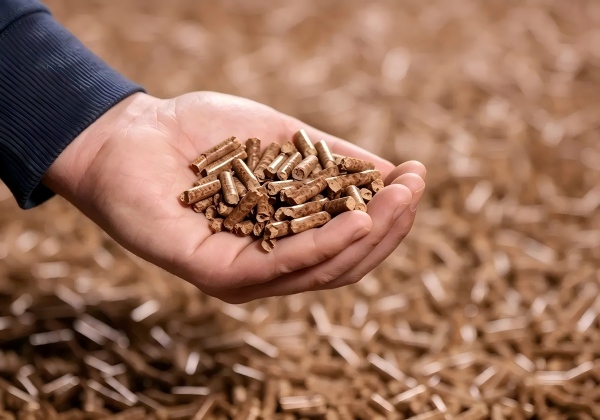
Straw pelletizing is a practical way to convert agricultural residues into compact, easy-to-handle biomass pellets. Wheat straw, rice straw, corn stalks, barley straw, oat straw, sorghum stalks, and other crop residues can be processed into pellets for fuel, heating, animal bedding, or other applications depending on their characteristics and local requirements.
However, producing high-quality straw pellets is not simply a matter of feeding loose straw into a pellet mill. A commercial production line normally includes several types of equipment, with each machine performing a specific function. Raw straw may contain long fibers, excess moisture, dust, soil, stones, and other contaminants. Its low bulk density also makes feeding and transportation difficult.
A complete straw pelletizing system therefore combines material preparation, size reduction, moisture control, pelletizing, cooling, screening, conveying, and packaging equipment.
For companies planning to invest in a straw pellet making machine, understanding the role of each piece of equipment is important. The right configuration depends on the type of straw, moisture content, required capacity, pellet diameter, final application, and degree of automation.
This article explains the main equipment used for straw pelletizing and how these machines work together to form a complete production line.
What Is the Basic Straw Pelletizing Process?
Although the exact configuration varies between projects, a typical straw pellet production process can be described as:
Raw Straw → Cleaning → Bale Breaking → Shredding → Drying → Grinding → Moisture Adjustment → Pelletizing → Cooling → Screening → Packaging
Material may be transported between these stages using conveyors, bucket elevators, screw conveyors, or other conveying equipment.
Not every plant requires every machine. For example, relatively clean and dry straw may need less cleaning and drying, while wet baled straw with long fibers may require extensive preprocessing.
The main equipment categories include:
- Raw material cleaning equipment
- Bale breakers
- Straw shredders
- Dryers
- Hammer mills or straw grinders
- Mixers and conditioning equipment
- Feeding systems
- Straw pellet mills
- Pellet coolers
- Vibrating screens
- Conveyors and elevators
- Packing machines
- Dust collection systems
- Electrical control systems
1. Raw Material Cleaning Equipment
Cleaning is the first important step for many straw pellet plants.
Agricultural straw can contain foreign materials picked up during harvesting, baling, transportation, or storage. These may include:
- Soil
- Sand
- Stones
- Metal pieces
- Plastic
- Twine
- Other agricultural residues
A cleaning screen or pre-cleaner can remove a portion of unwanted materials before they enter the main processing equipment.
Why Is Straw Cleaning Important?
Foreign materials can damage shredders, grinders, dies, and rollers.
A small amount of soil may not appear significant, but continuous processing of abrasive materials can accelerate equipment wear.
Metal is an even greater concern because it can damage rotating equipment and create safety risks.
For this reason, a magnetic separator may also be installed to remove ferrous metal particles.
The exact cleaning configuration depends on the quality of the incoming straw.
2. Bale Breaker
Large-scale straw is often collected and transported in bales.
Bales are convenient for agricultural transportation and storage, but they cannot normally be fed directly into a pellet mill.
A bale breaker is used to separate compressed straw into smaller and more manageable pieces.
The machine loosens the compacted bale and provides a more consistent material flow for downstream processing.
Benefits of a Bale Breaker
A bale breaker can:
- Reduce manual labor
- Improve continuous feeding
- Break large compressed bales
- Prepare straw for shredding
- Increase the stability of the production line
For large commercial plants receiving baled straw, the bale breaker can be an important part of the front-end system.
3. Straw Shredder
After bale breaking, straw may still contain long fibers.
A straw shredder cuts long straw into shorter pieces before fine grinding.
This is particularly important for materials such as:
- Wheat straw
- Rice straw
- Corn stalks
- Barley straw
- Oat straw
Why Is Shredding Necessary?
Long fibers can cause several problems.
They may:
- Wrap around rotating components
- Bridge inside hoppers
- Cause unstable feeding
- Reduce grinding efficiency
- Increase the risk of blockages
Shredding reduces the physical size and fiber length of the material.
The resulting material is easier to transport and grind.
4. Straw Dryer
Moisture is a critical factor in straw pelletizing.
Fresh or poorly stored straw may contain too much moisture for efficient pellet production.
An industrial rotary dryer machine is commonly used in larger biomass processing plants to reduce moisture before pelletizing.
How Does a Straw Dryer Work?
A rotary dryer generally uses controlled hot air to remove water from the straw.
Material enters the rotating drum and moves through the drying zone while hot air transfers heat to the material.
The actual drying conditions depend on:
- Initial moisture
- Target moisture
- Material size
- Throughput
- Heat source
- Ambient conditions
Why Is Moisture Control Important?
Excessively wet straw can cause:
- Poor pellet formation
- Lower pellet durability
- Higher energy consumption
- Die blockage
- Unstable feeding
- Difficult cooling
However, excessive drying is also undesirable because it can increase dust and may negatively affect pellet formation.
The goal is to achieve a stable moisture condition suitable for pelletizing.
5. Hammer Mill or Straw Grinder
After drying and initial shredding, straw usually needs further size reduction.
A hammer mill is commonly used for this purpose.
The machine uses high-speed rotating hammers to reduce the straw into smaller particles.
Why Does Particle Size Matter?
Pelletizing works through compression.
If straw particles are too large or contain excessively long fibers, the material may not compress uniformly.
Proper grinding helps improve:
- Material flow
- Compression
- Pellet consistency
- Feeding stability
- Die performance
The correct particle size depends on the straw type, pellet diameter, pellet mill design, and final application.
The material should not necessarily be ground into extremely fine powder. Excessive grinding can increase electricity consumption and dust without providing a proportional improvement in pellet quality.
6. Moisture Adjustment and Conditioning Equipment
After drying and grinding, the material may need moisture adjustment or conditioning.
The purpose is to create a relatively uniform material condition before it enters the pellet mill.
A mixer or conditioning system can be used when moisture or other materials need to be distributed evenly.
For certain applications, steam or water may be introduced in a controlled manner.
Why Is Conditioning Useful?
Conditioning can help stabilize:
- Moisture
- Material temperature
- Particle distribution
- Feed consistency
The exact conditioning method depends on the raw material and pelletizing process.
For simple biomass fuel pellet production, the configuration may be more straightforward than that used in compound animal feed production.
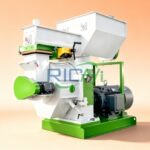
7. Straw Pellet Making Machine
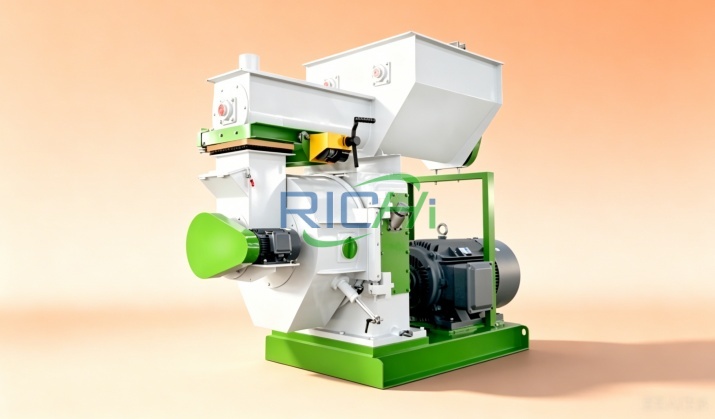
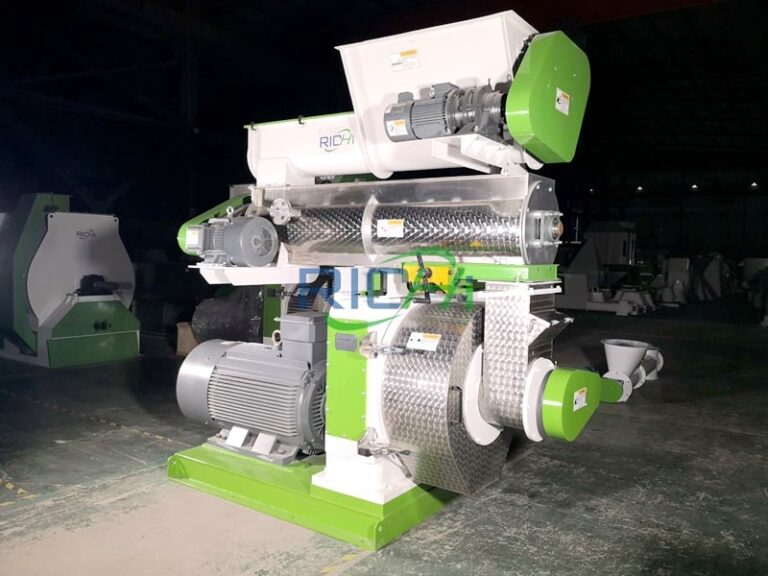
The core equipment in the production line is the pellet mill.
The straw pellet making machine compresses prepared straw into cylindrical pellets through a die.
Depending on the production system, biomass pellet mills may use ring dies or flat dies.
For commercial high-capacity plants, ring die pellet mills are commonly selected because they are designed for continuous industrial pellet production.
(Learn more:https://richipelletizer.com/straw-pellet-machine-for-sale/)
How Does a Straw Pellet Machine Work?
Prepared straw enters the pellet mill through the feeding system.
Inside the pelletizing chamber, rollers press the material against the die.
The combination of:
- Mechanical pressure
- Friction
- Heat
- Material characteristics
- Die compression
causes the straw to pass through the die holes and form continuous strands.
Knives then cut the strands into pellets of the required length.
The final pellet diameter is determined primarily by the die hole diameter.
8. Pellet Mill Die
The die is one of the most important components of a straw pellet mill.
It determines the pellet diameter and strongly affects the resistance encountered during compression.
Different straw materials may require different die compression ratios.
Why Does Compression Ratio Matter?
If resistance is too low, pellets may have poor density or durability.
If resistance is too high, motor load can increase and the die may become more difficult to operate.
The suitable compression ratio depends on:
- Straw species
- Moisture
- Particle size
- Pellet diameter
- Fiber characteristics
- Required pellet quality
Therefore, die selection should be based on actual raw material testing rather than using one die specification for every type of straw.
9. Rollers
Rollers work together with the die to compress straw.
During operation, the rollers rotate while applying pressure to the material.
The condition of the rollers directly affects pelletizing performance.
Important considerations include:
- Roller surface condition
- Bearing condition
- Roller clearance
- Wear resistance
- Lubrication
- Alignment
Worn rollers can reduce pelletizing efficiency and cause uneven material compression.
Regular inspection is therefore essential.
10. Pellet Cooler
Fresh pellets leave the pellet mill at an elevated temperature.
They also contain residual moisture.
A pellet cooler is used to reduce pellet temperature and stabilize the product.
Counterflow coolers are commonly used in industrial pellet production.
Why Is Cooling Necessary?
Proper cooling can improve:
- Pellet strength
- Storage stability
- Packaging performance
- Handling
- Moisture distribution
Packaging hot pellets immediately can cause condensation inside bags or storage containers.
Therefore, cooling is an important downstream process rather than an optional finishing step.
11. Vibrating Screen
After cooling, pellets are screened.
The purpose of screening is to separate finished pellets from:
- Fines
- Broken pellets
- Oversized material
- Unwanted particles
A vibrating screen provides continuous separation.
What Happens to the Fines?
In many pellet plants, acceptable fines can be recycled back into the pelletizing process.
This can improve material utilization and reduce product loss.
Screening also improves the consistency of the final product delivered to customers.
12. Conveyors and Elevators
A commercial straw pellet plant requires continuous material movement between machines.
Common conveying equipment includes:
- Belt conveyors
- Screw conveyors
- Bucket elevators
- Chain conveyors
Why Is Material Conveying Important?
An efficient conveying system should:
- Maintain stable material flow
- Minimize material loss
- Reduce manual handling
- Connect equipment efficiently
- Prevent unnecessary transfer points
The conveying system should be designed together with the production line instead of being treated as an afterthought.
13. Packing Machine
After screening, finished straw pellets can be packaged.
Packing equipment may include automatic weighing and bagging systems.
The appropriate packaging method depends on the target market.
Common options include:
- Small retail bags
- Medium-size bags
- Large bags
- Bulk loading
An automatic packing system can improve weighing accuracy and reduce manual labor.
For large plants, automatic bagging can also improve overall production efficiency.
14. Dust Collection System
Straw processing produces dust, particularly during:
- Shredding
- Grinding
- Conveying
- Screening
- Pelletizing
A dust collection system can capture airborne particles from appropriate processing points.
A complete system may include:
- Dust hoods
- Ductwork
- Fans
- Cyclones
- Bag filters
- Collection equipment
Dust control should be integrated into the plant design from the beginning.
The exact design should follow applicable local industrial safety requirements and the characteristics of the biomass being processed.
15. Electrical Control System
A modern straw pelletizing line usually requires an electrical control system to coordinate the equipment.
A centralized control system can monitor and manage:
- Motor operation
- Feeding rate
- Dryer conditions
- Pellet mill load
- Conveyor status
- Cooler operation
- Alarms
- Emergency shutdowns
Automation can help maintain consistent operation and reduce the need for manual intervention.
However, operators are still important for monitoring raw material changes, machine conditions, maintenance, and abnormal situations.
How These Machines Work Together
A complete straw pelletizing plant is not simply a collection of individual machines.
The machines must be properly matched.
A typical process can be divided into four sections.
Section 1: Raw Material Preparation
Straw Receiving → Cleaning → Bale Breaking → Shredding
The purpose is to turn agricultural residues into a manageable feedstock.
Section 2: Material Conditioning
Drying → Grinding → Moisture Adjustment
The purpose is to establish suitable moisture and particle size.
Section 3: Pellet Production
Feeding → Pelletizing → Cooling → Screening
This is the core production section.
Section 4: Finished Product Handling
Conveying → Packaging → Storage
This section prepares the pellets for transportation and sale.
How to Choose Equipment for a Straw Pellet Plant
Equipment selection should begin with the raw material rather than the machine model.
1. Raw Material Type
Wheat straw and rice straw do not necessarily behave identically during processing.
The fiber length, moisture, ash content, density, and physical structure should be considered.
2. Initial Moisture
High-moisture straw may require a larger drying system.
Dry straw may require little or no industrial drying.
3. Required Capacity
A plant producing 1 ton per hour has different equipment requirements from a plant producing 10 or 20 tons per hour.
The capacity of the dryer, grinder, pellet mill, cooler, screen, and packaging system should be balanced.
4. Pellet Diameter
Different markets may require different pellet diameters.
Common biomass pellet sizes include several millimeter diameters, but the actual requirement depends on the intended application and market specification.
5. Final Application
The equipment configuration can differ depending on whether pellets are intended for:
- Industrial heating
- Biomass boilers
- Agricultural heating
- Household heating
- Bedding
- Other biomass applications
6. Automation Level
A small plant may use relatively simple controls.
A large commercial straw pellet plant may benefit from centralized automatic control, sensors, variable-frequency drives, automatic feeding, and production monitoring.
Why a Complete Turnkey Solution Can Be Important
Buying a pellet mill alone does not guarantee a successful straw pellet project.
The pellet mill needs properly prepared material.
If straw is too wet, the dryer may become the production bottleneck.
If straw is too coarse, the grinder may limit pellet mill performance.
If cooling capacity is insufficient, finished pellets may not be stable enough for packaging.
If the screening system is undersized, fines may accumulate.
Therefore, the entire production line should be designed as one integrated system.
A turnkey supplier can evaluate:
- Raw materials
- Moisture
- Particle size
- Required capacity
- Pellet diameter
- Factory layout
- Energy requirements
- Equipment configuration
- Automation
- Installation
- Commissioning
- Operator training
- After-sales service
Example of a Complete Straw Pelletizing Line
For a commercial agricultural waste pellet project, a typical configuration could include:
Raw Straw Receiving System
↓
Cleaning Screen
↓
Magnetic Separator
↓
Bale Breaker
↓
Straw Shredder
↓
Rotary Dryer
↓
Hammer Mill
↓
Buffer Hopper
↓
Feeding System
↓
Straw Pellet Making Machine
↓
Counterflow Pellet Cooler
↓
Vibrating Screen
↓
Automatic Packing Machine
↓
Finished Pellet Storage
The actual configuration can be changed according to the customer’s raw materials, capacity, moisture, pellet size, and factory conditions.
Common Equipment Problems in Straw Pelletizing
Poor Pellet Quality
Possible causes include unsuitable moisture, incorrect particle size, inappropriate die compression, worn rollers, or unstable feeding.
Low Production Capacity
Possible causes include insufficient drying, inadequate grinding capacity, unstable feeding, excessive die resistance, or undersized downstream equipment.
Frequent Die Blockage
Possible causes include high moisture, excessive fiber length, foreign materials, poor grinding, or incorrect die selection.
Excessive Fines
Possible causes include poor compression, inappropriate moisture, worn die or rollers, insufficient cooling, or excessive mechanical handling.
High Energy Consumption
Potential factors include excessive moisture, over-drying, overly fine grinding, excessive die resistance, inefficient motors, and poor line matching.
Maintenance of Straw Pelletizing Equipment
Regular maintenance is essential for stable operation.
Operators should regularly inspect:
- Dies
- Rollers
- Bearings
- Gearboxes
- Motors
- Conveyors
- Dryer components
- Grinder screens
- Dust collection equipment
- Coolers
- Electrical systems
Lubrication should follow the equipment manufacturer’s requirements.
Worn components should be replaced before they cause secondary damage or extended downtime.
Cleaning is also important because accumulated straw dust can affect equipment operation and workplace safety.
How to Improve Overall Straw Pelletizing Efficiency
A well-designed line should focus on the entire process rather than only the pellet mill.
Several measures can improve efficiency:
Maintain Stable Raw Material Moisture
Consistent moisture makes pelletizing easier to control.
Optimize Particle Size
Use appropriate shredding and grinding rather than excessive size reduction.
Match Equipment Capacities
The dryer, grinder, pellet mill, cooler, screen, and packaging machine should have compatible capacities.
Reduce Unnecessary Material Handling
Efficient conveyor layouts can reduce energy use and product damage.
Monitor Pellet Mill Load
Motor load can provide useful information about feeding and die resistance.
Maintain the Die and Rollers
Worn components can reduce pelletizing performance.
Use Appropriate Automation
Automatic control can improve consistency and simplify monitoring.
Frequently Asked Questions
What is the main machine used for straw pelletizing?
The pellet mill is the core machine because it compresses prepared straw into pellets. However, commercial plants normally require additional equipment for cleaning, shredding, drying, grinding, cooling, screening, and packaging.
Can straw be pelletized without drying?
It depends on the initial moisture content. If the straw is already within a suitable moisture range, separate drying may not be necessary. Wet straw generally requires moisture reduction before pelletizing.
What machine is used to break straw bales?
A bale breaker is commonly used to loosen compressed straw bales before shredding and grinding.
Why does straw need to be shredded before pelletizing?
Shredding reduces long fibers and improves feeding and grinding stability.
What equipment reduces straw particle size?
A straw shredder performs initial size reduction, while a hammer mill or grinder can further reduce the material.
Why is a cooler needed after pelletizing?
Fresh pellets are hot after compression. Cooling reduces their temperature and helps stabilize them before screening and packaging.
What does a vibrating screen do?
It separates finished pellets from fines and broken pellets. Suitable fines can often be recycled into the pelletizing process.
Is a straw pellet mill enough to build a production line?
For a commercial project, usually not. A complete system normally needs material preparation, moisture control, pelletizing, cooling, screening, conveying, and packaging equipment.
What should I consider when buying a straw pellet making machine?
Consider the straw type, moisture, required capacity, pellet diameter, particle size, die compression ratio, automation level, equipment durability, energy consumption, maintenance requirements, and compatibility with the complete production line.
(click to find out more:RICHI Pelletizer)
Conclusion
Straw pelletizing requires more than a single pellet mill. Because agricultural residues can vary significantly in moisture, fiber length, particle size, bulk density, and contamination, a complete production line needs several stages of preparation and processing.
The major equipment used for straw pelletizing includes cleaning equipment, bale breakers, shredders, dryers, hammer mills, conditioning systems, pellet mills, coolers, vibrating screens, conveyors, packing machines, dust collection systems, and electrical control systems.
Among these machines, the straw pellet making machine is the core pellet-forming equipment, but its performance depends heavily on the machines installed before and after it.
A properly designed system prepares straw to the appropriate moisture and particle size, provides stable feeding, applies suitable compression, cools the finished pellets efficiently, removes fines, and packages the final product safely.
For this reason, choosing straw pelletizing equipment should begin with a detailed assessment of the raw material and production requirements. A complete, properly balanced system can provide more stable operation and make agricultural residues easier to process into a consistent and commercially useful pellet product.